Waxed concrete in the bathroom: is it a good idea for your renovation?
If the mineral allure of waxed concrete is immediately appealing, the question of its water resistance often turns this aesthetic choice into a technical issue for homeowners. This dossier compares the reality of the field with the decorative promises to determine how this seamless covering adapts to the constraints of your damp room, highlighting the professional methods that are essential to guarantee absolute waterproofing.
The appeal of continuity: a seamless aesthetic
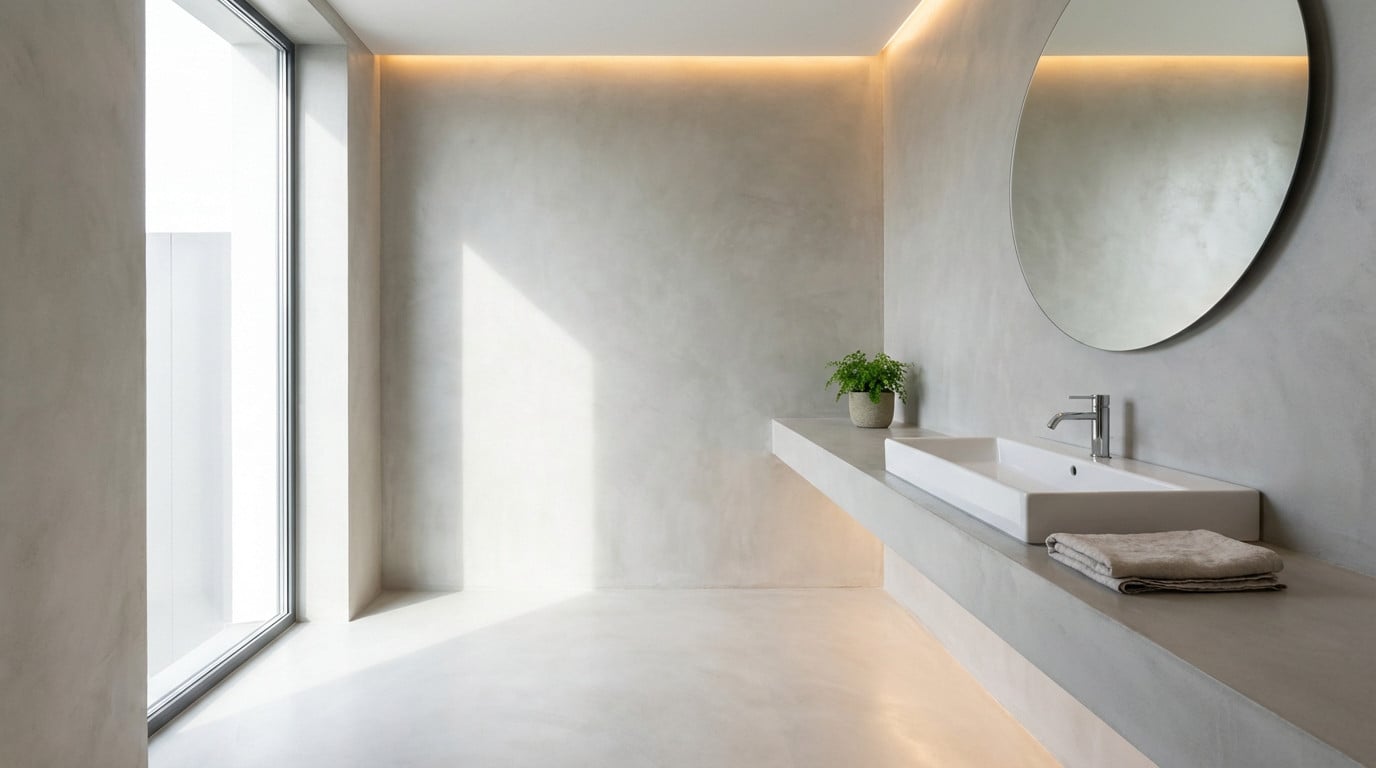
Can you see the main problem with tiling? Joints. They clog up the space visually and physically. Waxed concrete radically eliminates this visual noise. This continuous surface creates an immediate impression of space, offering a modern, minimalist purity that's ideal for small wet rooms.
This material is not just for cold industrial style. It's a chameleon that adapts well to Scandinavian or wabi-sabi atmospheres. In fact, it works very naturally with noble materials such as wood, glass and metal. The big technical advantage? Its thinness. With a thickness of just a few millimetres, it can be used to renovate existing tiles, avoiding the need for major demolition work.
A range of finishes for a unique look
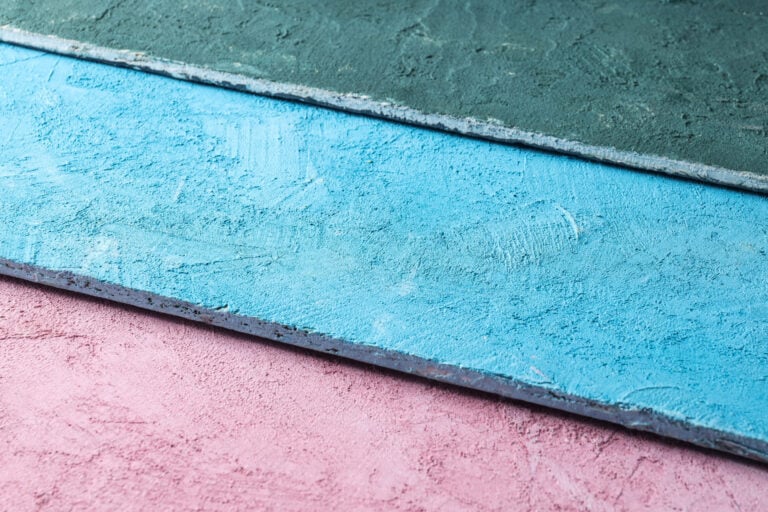
Forget standardised solutions. Thanks to a wide range of colours and pigments, you can create a totally bespoke ambience. Smoothed, ironed or moiré, the textures change everything. The final result depends entirely on the craftsman's know-how, whose touch creates a visual signature that is impossible to reproduce industrially.
An appreciable technical detail: its excellent thermal conductivity makes it perfectly compatible with underfloor heating, ensuring optimum comfort.
Myths and realities: the truth about waterproofing
There is a persistent misconception that the watertightness of waxed concrete depends solely on the final coat of varnish. That's not true. Genuine water resistance, known as «waterproof», is built into the mass and through the methodical superimposition of technical layers.
And beware of slipping. A smooth, wet surface requires vigilance. Anti-slip treatment is an absolute necessity for safety, especially in the shower or around the bath.
Aesthetics have a technical cost. The lasting success of your waxed concrete project in Geneva depends entirely on rigorous control of these waterproofing and safety constraints.
Technical points to watch out for in wet environments
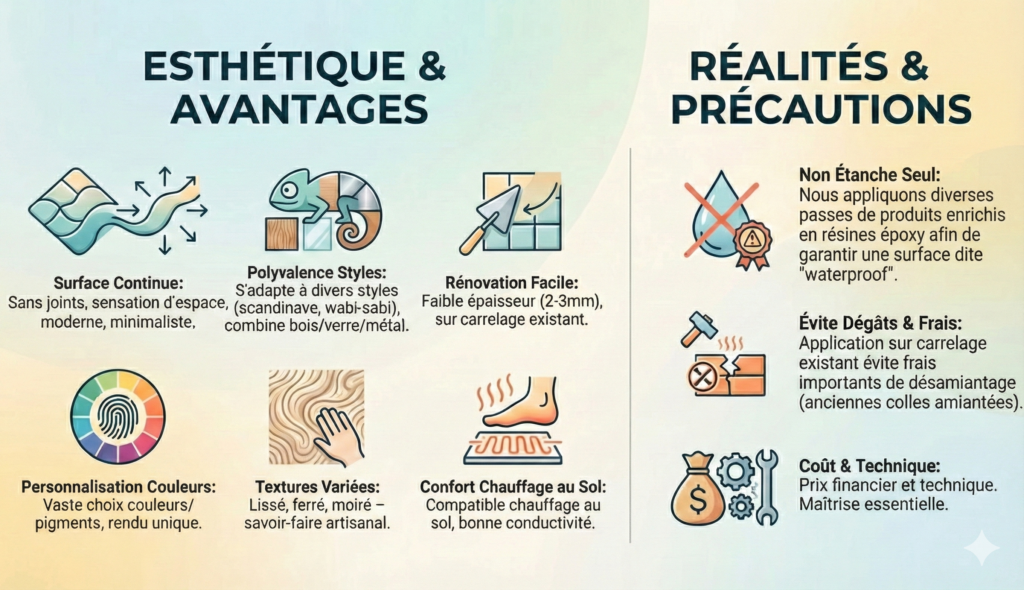
Once you've seen the aesthetic appeal, you need to look at the technical aspects, which make all the difference between a successful project and a disappointment.
Waterproofing: a complex multi-layer system
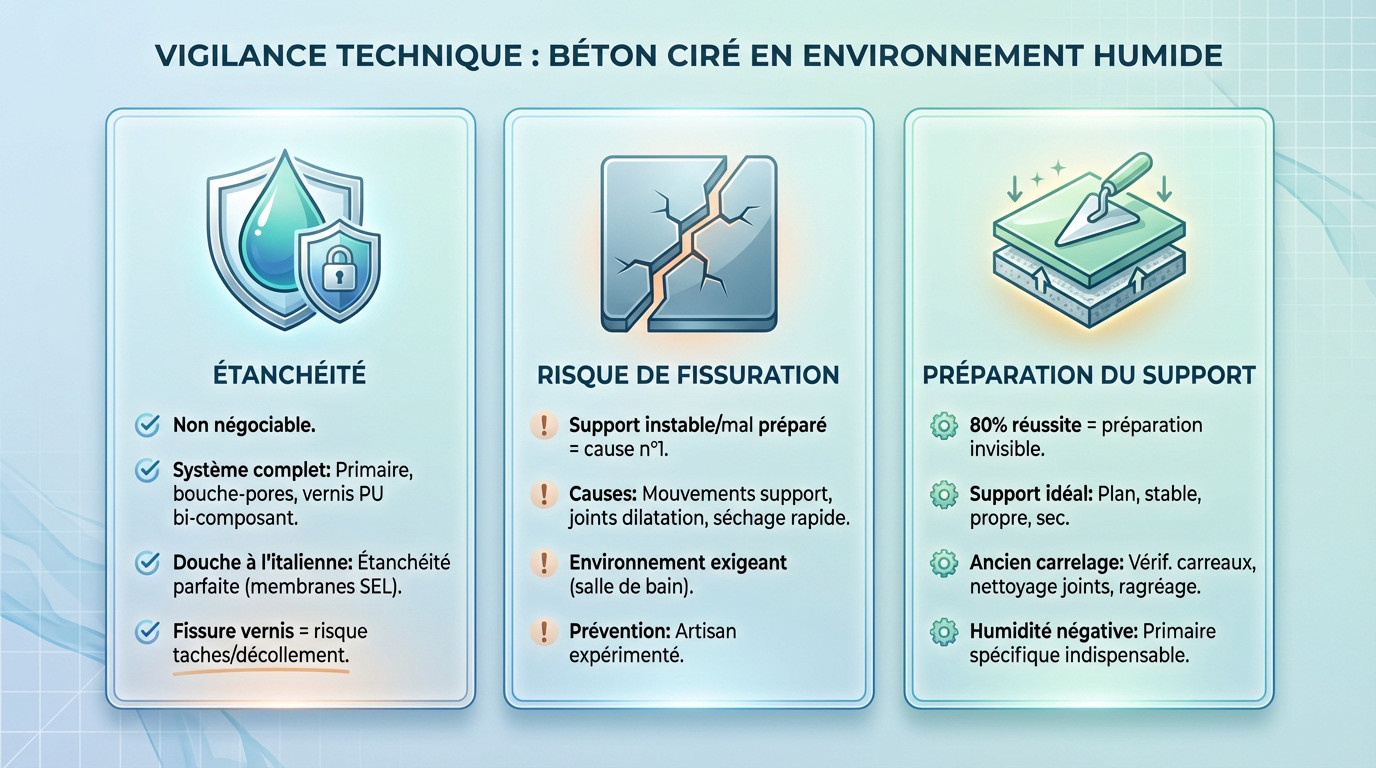
Contrary to popular belief, 100 % of waterproofing does not depend on the topcoat. To guarantee a totally waterproof surface, the secret lies in applying products enriched with epoxy resins well before finishing.
A high-performance waterproofing system is built in successive stages:
- Primer : To bond the coating to the substrate.
- Special cement (2 passes) : This is where the «waterproof» barrier comes into play. These technical layers create an impermeable structure beneath the decorative concrete.
- Waxed concrete (2 passes) : The contribution of decorative material and texture.
- Protective varnish (3 coats) : The finish, which protects against stains and makes maintenance easier, rounds off an already watertight system.
The risk of cracking: how can it be avoided?
Waxed concrete is a thin coating that follows the movements of the substrate. An unstable substrate is the number one cause of cracks. There are many potential causes: a shifting substrate, expansion joints that are not respected or drying too quickly.
Only an experienced craftsman will be able to diagnose the condition of the substrate and apply the right techniques (covering, suitable primers) to minimise this risk, especially as our resin-enriched complex offers greater flexibility than conventional waxed concretes.
Preparing the substrate: the invisible foundation
80% of success lies in preparation. The substrate must be perfectly flat, stable, clean and dry. On old tiles, this means making sure that none of the tiles move, and often applying a levelling compound. You also need to deal with «negative» humidity (capillary rise), which requires a special primer to guarantee adhesion.
The craftsman's know-how: the key to lasting results
Precision, not DIY
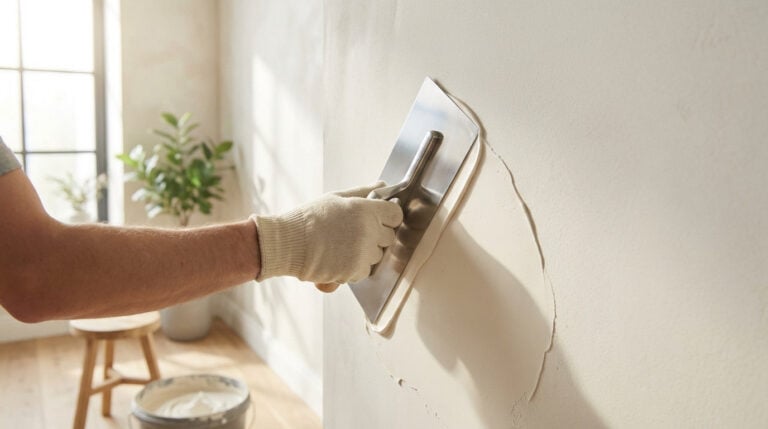
Successfully applying waxed concrete in the bathroom is a technical feat that cannot be improvised. It's a far cry from simple painting. It's an operation that requires an expert hand and compliance with a strict protocol.
A true professional controls invisible parameters: application temperature, hygrometry, precise proportions of resins and drying time between the 7 successive coats of the complete system.
Critical stages mastered by the professional
The craftsman follows an almost surgical protocol to guarantee the longevity of the work:
- Diagnosis of the substrate (humidity below 4%).
- Application of primer.
- Creation of the watertight shield via two passes of special enriched cement.
- Applying two coats of decorative waxed concrete.
- Meticulous sanding for texture.
- Application of 3 coats of varnish protector.
Each stage is interdependent. It is this technical millefeuille that guarantees resistance to water splashes.
How do you choose the right craftsman?
Insist on seeing concrete examples, ideally in damp rooms. A good professional will explain his waterproofing complex in detail (particularly the use of epoxy resins) and won't just tell you about the final varnish. His ability to explain invisible layers is a sign of his expertise.
For a long-lasting project with no nasty surprises, the best thing to do is to request a quote to a specialist company for a full diagnosis.
Day-to-day maintenance: keeping your waxed concrete spotless
Once the work is finished, appropriate maintenance is required to preserve the unique character of the flooring.
Simple steps to effective cleaning
The golden rule? Be gentle. Warm water and a pH-neutral soap (black soap, Marseille soap) are all you need. Avoid bleach, strong limescale removers and scouring powders that attack the surface protection. Use a microfibre cloth rather than abrasive tools.
Long-term protection
Although the core of the coating is waterproof thanks to the resins, the surface varnish is subject to daily abrasion. Applying a wax once or twice a year helps to maintain the shine. Depending on use, it may be advisable to have a new coat of varnish applied by a professional after a few years to maintain ease of cleaning.
Waxed concrete versus its competitors: the coatings match-up
Large format concrete effect tiles
Porcelain stoneware is a realistic imitation of concrete. Its greatest asset is its intrinsic robustness. Opting for XXL sizes means fewer joints, but they are still there and will eventually clog up. The contact remains cool underfoot, unlike the warmth of waxed concrete.
Epoxy or polyurethane resin
Like concrete, resin creates a unified surface. It is a technically watertight material. However, the result is often more «plastic» and shiny, far from the mineral, matt charm of real, hand-worked waxed concrete.
Comparison table
| Criteria | Waxed concrete (Reinforced Epoxy System) | Concrete effect tiles | Epoxy resin/PU |
| Aesthetics | Mineral, hand-crafted, unique look. Surface 100% continuous. | Realistic imitation, but with joints. | Smooth, modern appearance, potentially more «plastic». |
| Watertightness | Waterproof throughout (special cement + resins) + triple varnish. | Waterproof material. Joints are the weak point. | Naturally waterproof and seamless. |
| Maintenance | Neutral products only. | Very easy to use. Supports all products. | Easy. Beware of scratches. |
| Durability | Excellent resistance thanks to the multi-layer complex. | Highly resistant to impact and wear. | Very good chemical resistance. |
FAQ
What are the disadvantages of waxed concrete in a bathroom?
If it's not done properly, the main risk is infiltration. However, with our system reinforced with epoxy resins and special cement, this risk is kept under control. Maintenance simply means avoiding acidic products (strong limescale removers, bleach) to preserve the surface varnish.
Is it possible to apply waxed concrete in a bathroom?
Yes, it's an ideal renovation solution. Thanks to its thinness, it can cover old tiles without demolition. It is suitable for walls, floors and walk-in showers, provided a complete waterproofing complex is used, including technical layers under the decorative finish.
How long does waxed concrete last?
Applied by a specialist using resin-enriched products, it can last for over 20 years. If the structure is long-lasting, the surface varnish layer may need refreshing after a few years to keep it looking new.
Is it difficult to lay waxed concrete yourself?
Yes, it's a very technical process. Our method involves 7 separate layers (primer, special cements, concrete, varnish) with strict drying times. A mistake in the intermediate waterproofing layers can compromise the work. Expert advice is highly recommended.
Is waxed concrete a good or bad idea for renovation?
It's an excellent idea for achieving a refined look and visually enlarging the space, while avoiding breaking up the existing structure. It's a choice that enhances the value of the property through its upmarket character.
Is waxed concrete cheaper than tiles?
It's difficult to compare materials alone. Waxed concrete is a complete craftsman's service, where labour is predominant because of the time spent on the multiple layers (drying, sanding). It's an investment in manual skills rather than a standardised industrial product.
What are the alternatives to waxed concrete for damp rooms?
Large-format tiles remain the classic alternative, cooler but sturdier. Synthetic resins also offer a seamless solution, but with a less natural, less nuanced visual appearance than mineral waxed concrete.