
Changing your floor without demolition: polished concrete over existing tiles
Dated tiles, yellowed grout, a floor that no longer suits you: you’re keen to make a change, but the thought of tearing everything up is far less appealing. Chipping away at tiles means noise, dust, rubble to clear away and a room that’s unusable whilst the work is on. There’s another way: laying waxed concrete directly onto the existing tiling. Here’s how it works, what the requirements are, and what you need to know before you get started.
Why polished concrete can be laid over old tiles
Polished concrete is a thin coating: approximately 4 mm thick once finished. Made from cement mixed with resins, it adheres to a wide range of surfaces, including tiles, provided they are stable, clean and properly prepared. The tiles therefore remain in place and serve as the base for the new floor.
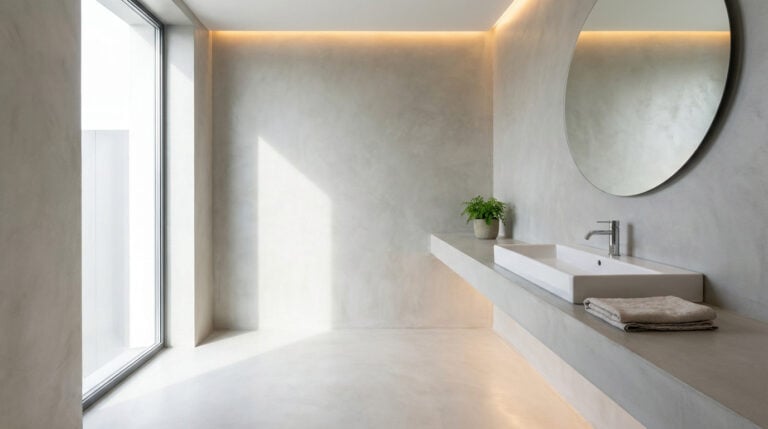
The result is a seamless surface, with no joints whatsoever, which completely conceals the original tiles. The room takes on a whole new look, even though nothing has been demolished.
What you avoid by not breaking it
- Removing the old tiles, with all the noise and dust that goes with it.
- The removal of rubble.
- Part of the reason for the project’s duration and cost: by carrying out the work on top of the existing structure, the entire demolition stage is eliminated.
- A significant rise in ground level: being only a few millimetres thick, it hardly moves at all.
Asbestos in old tile adhesives
This is a benefit that few people are aware of. Asbestos has been banned in Switzerland since 1990, and Suva points out that the tile adhesives used prior to that may contain it. The danger arises when tiles are chipped away: the adhesive breaks up and releases fibres. Covering the tiles rather than breaking them means you don’t have to touch the adhesive, thereby avoiding asbestos removal, which can be very expensive.
If your property was built before 1990, Suva requires you to check for the presence of asbestos before any work is carried out, however minor. Please let us know the year of construction when you request a quote: this is something that needs to be clarified before we can start.
Which types of tiles can be covered?
Most floor tiles are suitable for this, but not in just any condition. Polished concrete follows the movements of the substrate: if the substrate moves, the finish will eventually show it. Before recommending this solution, we therefore check several points.
- No tiles should shift or come loose. An unstable tile is a potential weak spot.
- The floor shows no signs of structural cracking. A subfloor that moves is the main cause of cracks in polished concrete.
- The surface is clean and free of grease. In a kitchen, this is important.
- The substrate is dry: the moisture content must be less than 4 per cent. If there is rising damp from the ground, a special primer is required to ensure adhesion.
- The floor is level. On top of old tiling, a levelling compound is often applied to create a smooth surface before the polished concrete is laid.
This assessment of the substrate makes all the difference between a floor that lasts and one that proves to be a disappointment. That is why preparation is just as important as the finish.
The steps involved in laying a polished concrete floor over tiles
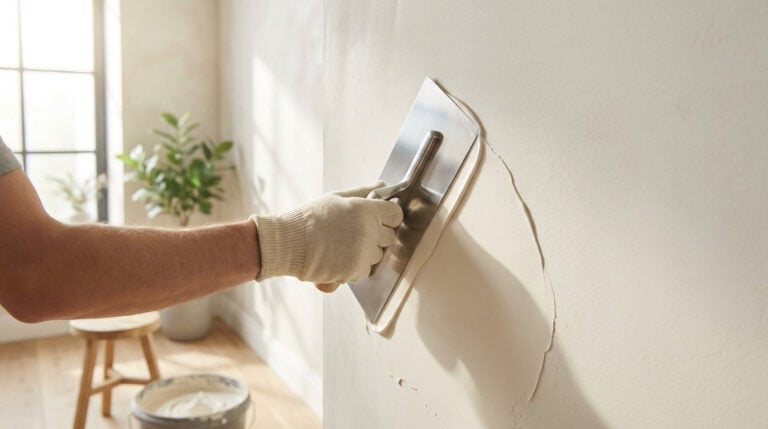
Polished concrete is built up layer by layer, with a drying time between each layer and specific temperature and humidity conditions that must be observed. When applying it over existing tiling, the process generally follows this sequence:
- Assessment of the substrate: stability of the tiles, condition of the floor, moisture content.
- Preparation: cleaning and degreasing the tiles, followed by levelling if the surface needs to be levelled out.
- The primer, which bonds the new coating to the tiles.
- The layers of polished concrete, which provide the material, colour and texture.
- Sanding, to smooth the surface.
- The layers of protective varnish, which protect the floor from stains and make it easier to look after.
In a bathroom or walk-in shower, the system is reinforced: two coats of special resin-enriched cement are applied before the decorative polished concrete to ensure waterproofing throughout the structure, and the finish is completed with three coats of varnish. We explain this process in detail on our page dedicated to polished concrete for the bathroom.

In which rooms should you lay flooring in this way?
Living room, kitchen, hall
These are the rooms where old tiling is most noticeable. Once sealed with a varnish, polished concrete is resistant to knocks, scratches and everyday stains, and can withstand heavy footfall. It is also compatible with underfloor heating. In terms of style, it is available in matt, satin or gloss finishes, ranging from mineral grey to warmer shades, and complements both contemporary and more traditional interiors equally well.
Bathroom and walk-in shower
In wet rooms, we use a so-called «waterproof» polished concrete finish, the Wall2Floor Top Coat Waterproof: a two-component epoxy coating designed for damp environments. Even if the finish is scratched, it does not absorb water and does not change colour. It can be applied to both floors and tiled walls, allowing the entire room to be renovated in one go. A smooth, wet surface can be slippery: in the shower and around the bath, a non-slip treatment is essential. To find out more, read our article Polished concrete in the bathroom: is it a good idea?
Shops and offices
For a shop, covering the tiles rather than removing them minimises the time the premises are closed. When laid to the highest standards and properly protected, polished concrete can withstand foot traffic, the moving of furniture and high heels. We have, in fact, installed polished concrete floors for shops in Geneva.
What you need to know before you get started
- The result depends on the craftsman’s skill. Polished concrete is not the same as paint: getting the proportions right, allowing for drying times and sanding all require expertise. Ask to see examples of their work, ideally on old tiled floors.
- Maintenance is simple, with just one rule: no alkaline cleaning products. Gentle cleaning is sufficient, as there are no joints where dirt can become embedded. For bathrooms, we can supply products suitable for limescale.
- The protective coating requires maintenance. Depending on how often it is used, the varnish should be reapplied after a few years to keep it looking as good as new.
To find out more about everything we do with polished concrete – including floors, walls and bathrooms – please visit our page Waxed concrete, or browse our achievements.
Frequently asked questions about polished concrete over tiles
Have your tiles seen better days?
Please send us a few photos of your floor, the room’s floor area and the year the property was built. We’ll work with you to see if your tiles can be covered and how we would go about it. You can also call us on +41 22 503 97 91.